








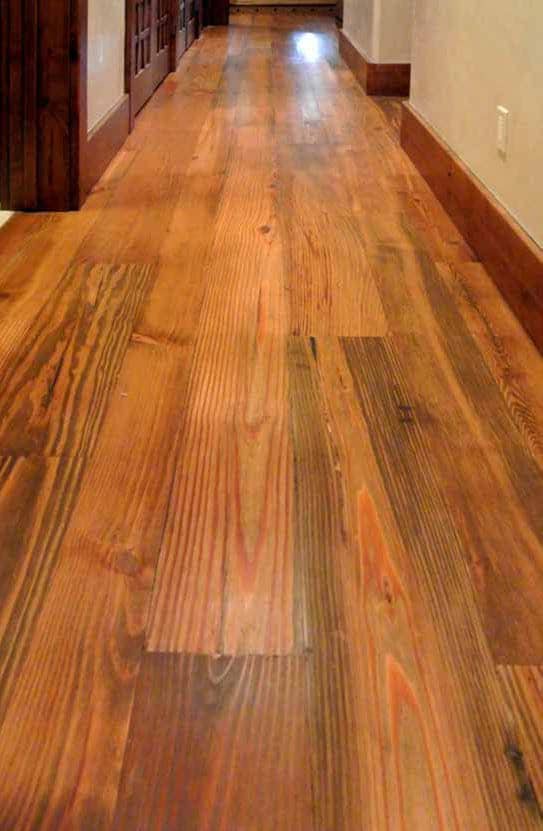
The most important part of a wood floor is the one you’ll never see. When people admire a hardwood floor, they notice the grain, color, texture, and craftsmanship. Hidden beneath the surface, however, is the tongue and groove, a precision engineered joint that aligns each board and locks thousands of individual planks into a single, unified floor.
Invisible after installation, the tongue and groove is far more than a method of joining boards together. Every profile is engineered carefully to simplify installation, maintain precise board alignment, and preserve the floor’s mechanical integrity as the wood naturally expands and contracts throughout its service life. Whether the flooring is solid or engineered, the tongue and groove is the unseen technology that makes a wood floor both beautiful and durable.
A BRIEF HISTORY OF TONGUE AND GROOVE
The tongue and groove joint has been used in woodworking for centuries, with documented examples appearing in European furniture, cabinetry, and shipbuilding as early as the seventeenth century. Long before modern wood flooring existed, craftsmen recognized that interlocking profiles produced stronger, better-aligned joints than simple square edges.
The industrialization of tongue-and-groove flooring began in 1828, when William Woodworth received U.S. Patent X5315 for his planing machine. His invention mechanically surfaced, tongued, and grooved boards in a continuous operation, dramatically increasing production efficiency and laying the foundation for the modern wood flooring industry. While earlier planing machines existed, including Malcolm Muir’s machine in Scotland (1817) and other experimental designs, Woodworth’s invention became the first successful machine commercially to transform the North American lumber industry and laid the technological foundation for the mass production of tongue-and-groove flooring.
Throughout the nineteenth century, inventors continued refining these machines specifically for manufacturing wood flooring. By the 1850s, patents had been issued for machines dedicated to producing tongue-and-groove flooring, and by the mid-1880s, inventors such as William M. Dwight and Edward H. N. Clarkson had developed sophisticated planing-and-matching machines capable of surfacing, ripping, tonguing, and grooving flooring in a continuous manufacturing process. These innovations established the precision machining methods that remain the basis of modern hardwood flooring production.
As the wood flooring industry matured and organizations were established, such as the Maple Flooring Manufacturers Association (MFMA) in 1898, and the National Oak Flooring Manufacturers Association (NOFMA) in 1909, manufacturing standards evolved to ensure consistent machining quality, profile dimensions, and product performance across the industry.
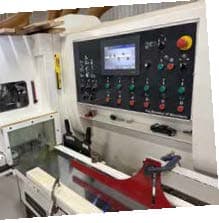
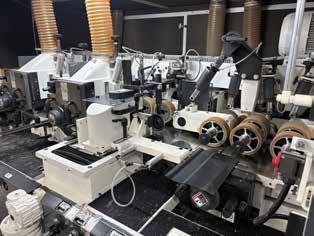
Although manufacturing equipment has advanced dramatically during the past two centuries, from early line-shaft, belt-driven side-matchers and end-matchers to today’s high-speed flooring moulders with computerized controls, precision feed systems, and advanced tooling, the fundamental engineering of the tongue and groove profile has changed very little. It remains one of the simplest and most effective methods ever developed for joining pieces of wood, allowing individual boards to install as a unified floor while accommodating the natural movement of wood throughout its service life.
UNDERSTANDING THE COMPONENTS
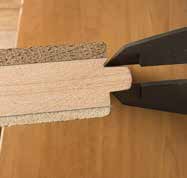
Every flooring board has two primary mating surfaces:
• Tongue: A precisely machined projection along one edge or end of the board.
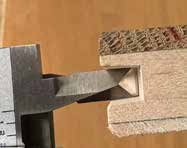
• Groove: A matching channel that receives the tongue of the adjoining board.
Separately, these features have little value. Together, they form the mechanical joint that transforms thousands of individual planks into one continuous floor. The tongue and groove aligns adjacent boards and creates the tight fit that gives wood flooring its strength and stability.
Modern tongue-and-groove profiles are machined to tolerances measured to the thousandths of an inch. That precision affects how easily the flooring installs and how accurately the boards fit together.
SIDE MATCH VS. END MATCH
Most hardwood flooring is machined in two directions, at the ends (end-match), and along the runs (side-match).
End-Match: The end-match refers to the tongue and groove machined into the short ends of flooring boards.
Before end-matching was introduced in 1898, flooring boards had to end over floor joists where they could be fastened. As plywood and structural panel subfloors became common, end-matching allowed adjoining boards to lock together between joists, reducing waste, improving alignment, and speeding installation.
During installation, the side-match and end-match engage simultaneously. The end-match aligns adjoining board ends while the side-match provides the floor’s primary structural connection.
Installers often notice the end-match fits more loosely than the side-match. This is intentional and reflects good engineering, not poor machining. A tight end-match fit would make installation difficult by causing boards to bind as both joints are engaged simultaneously. A slightly looser fit allows boards to assemble more easily while still maintaining proper alignment.
Side-Match: The long edges of each board contain the side-match. This joint serves as the primary structural interlock that keeps adjacent boards aligned across the width of the floor, helps maintain a flat surface, distributes loads between boards, and controls how the floor responds to normal expansion and contraction.
There are two components to the side-match that are important to their function.
Match-fit describes the relationship between the tongue thickness and groove width, determining how easily adjoining boards assemble. Contrary to popular belief, an ideal tongue-and-groove joint is not intended to fit tightly. NWFA/NOFMA voluntary manufacturing standards for solid wood specify a small clearance (approximately 0.003–0.016 inch) to allow boards to engage easily during installation while maintaining full mechanical interlock. Most wood flooring manufacturers have their own proprietary tongue-and-groove profiles, many of which incorporate different clearances based on the product design and intended performance.
An often-overlooked factor affecting match-fit is wood’s natural movement through its thickness. As moisture content changes, the tongue and groove may become slightly thicker or thinner, subtly changing how difficult or how easily they fit together. This principle applies to both solid and many premium engineered wood floors.
While rift and quartersawn wood is recognized widely as being exceptional in its dimensional stability across its width, it shrinks and swells nearly twice as much radially (through its thickness). As a result, tongue-and-groove joints manufactured from quartersawn material may fit slightly tighter or looser as moisture conditions change. These minor variations are a normal consequence of wood’s hygroscopic nature, not evidence of poor machining. As long as the tongue fully seats within the groove and the flooring is installed under proper environmental conditions, minor variations in match-fit are entirely normal and are anticipated by the manufacturing tolerances.
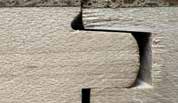
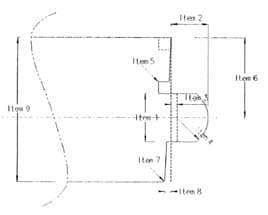
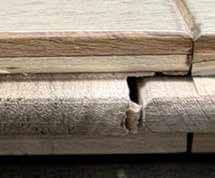
Match-Position: While match-fit influences how easily flooring is assembled, match-position is the machining dimension that ultimately determines the quality of the finished installation. It is arguably the single most important dimension in hardwood flooring manufacturing. Match-position describes the precise vertical relationship between two adjoining boards after the tongue and groove are fully seated, as seen in the image above. NWFA/NOFMA Manufacturing Standards for solid wood limit this variation to 0.008 inch or less, reflecting the extraordinary precision required to manufacture quality hardwood flooring.
When flooring is installed over a properly prepared, flat substrate, the bottom shoulder of the tongue bears firmly against the lower lip of the groove. This bearing surface establishes how flat the board sits on the subfloor, while maintaining the finished height of adjacent boards. Every board references this same machined surface, allowing the entire floor to install at a consistent elevation. This is why subfloor preparation is inseparable from machining quality. Even perfectly manufactured flooring cannot maintain proper match- position if the substrate contains high and low spots.
When a board bridges an uneven subfloor, the bottom of the groove cannot be fully or properly drawn in to the bottom of the tongue, forcing the board to rock or remain slightly elevated. The result may produce a noisy floor, or appear to be poor milling, when in reality, the profile is simply unable to register properly against an uneven substrate. Conversely, when the flooring is manufactured within tolerance and installed over a substrate that meets NWFA flatness requirements, the tongue and groove profile naturally aligns adjacent boards into a flat and uniform surface. This mechanical registration is the primary reason why proper subfloor preparation is critical to a successful installation.
THE ROLE OF TONGUE AND GROOVE IN FLOOR PERFORMANCE
One of the most remarkable aspects of a well-manufactured hardwood floor is that its most sophisticated engineering is never seen once the installation is complete. Far more than a means of connecting boards, the tongue-and-groove profile is a precision-engineered system that governs board alignment, mechanical engagement, load transfer, and the floor’s long-term performance.
The side-match provides the floor’s primary structural connection, while the end-match improves board-end alignment and installation efficiency. Together, these machined profiles create a flat, stable surface capable of accommodating the natural expansion and contraction of wood without sacrificing mechanical engagement. Yet even the most precisely manufactured flooring cannot overcome poor installation or unfavorable jobsite conditions. Proper acclimation, moisture management, a flat substrate, and stable interior environmental conditions all are essential for the tongue-and-groove system to perform as intended.
Although hidden from view, the tongue and groove remains one of the most important engineering features of every hardwood floor. Its precision influences not only how efficiently a floor is installed, but also how well it performs, making it the unseen foundation of every beautiful, durable wood floor.
Brett Miller is the general manager of Olde Wood Ltd. in Magnolia, Ohio. He has more than 35 years of experience in the hardwood flooring industry as an installer, finisher, inspector, and educator. He previously served as the vice president of technical standards, education, and certification for the National Wood Flooring Association (NWFA).
