









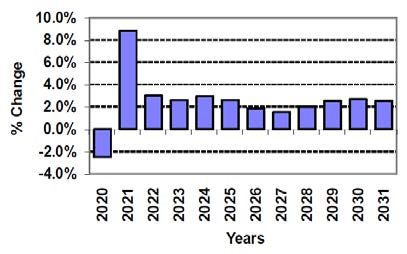
The overall U.S. economy is expected to grow slowly during this early period of economic uncertainty (in 2026 and 2027) and then grow at a more moderate rate thereafter. Consumer spending will continue to drive the economy, growing throughout the forecast period.
This economic forecast is projecting Real GDP growth in 2026 to be 2.2 percent, real consumer spending rising 1.9 percent, and inflation at 3.2 percent. Key assumptions underlying this forecast include:
- Strong demand continues to support economic activity, though uncertainties around tariffs, general affordability issues, and government policies will slow growth in the near term.
- New home construction in 2026 will continue to be constrained by affordability issues, mainly affecting younger buyers. High home prices remain inflated by under-supply, moderately high mortgage rates (+6 percent), and investors driving up demand in some markets, will continue to restrain housing growth. However, in 2027, existing home sales will grow, achieving nearly 5 million units annually. The housing market will not be a significant driving force for the economy as in the past.
- Real disposable personal income will grow moderately in 2026, buoyed by growth in professional and skilled occupations and then accelerate as employment rises due to investment in domestic production plants coming on-line.
- Major investments, and thus economic expansion, largely will be on hold until the results of the pivotal 2026 mid-term elections are known, and it can be determined if any change in political control of Congress and legislative policies occurs.
- Non-residential construction will experience slow growth through 2026, another victim of economic and political uncertainty, high interest rates, and inflation, before resurging in 2027 and beyond. Corporate profits will remain strong throughout the forecast period, and this will stimulate renovation of non-residential buildings in 2027 and beyond.
- More foreign firms will establish flooring manufacturing operations and foreign plants in general (auto, semi-conductors, etc.) in the U.S. given logistical advantages, tariff avoidance, and rising labor costs abroad. Tariffs on U.S. imports will garner additional government revenue which will offset federal deficit spending somewhat, slowing the growth of U.S. inflation and U.S. dollar exchange value erosion.
- It is not expected that the war in Ukraine, the Middle East, or Iran, or any other global war or terrorist threat, will expand and threaten the U.S. economic growth. There is not expected to be any significant logistical interruptions during the course of this forecast.

There are several significant downside risks related to this forecast.
- Tariffs on U.S. imports could raise prices and inflation beyond forecasted levels, slowing consumer spending. The tariffs also could disrupt trade relationships and create logistical interruptions.
- Deficit spending, if continuing, will weaken the U.S. dollar and its position as the reserve currency which buffers the U.S. economy from severe inflation. Continued deficits also could accelerate inflation and interest rates severely threatening U.S. economic growth.
- The U.S. stock market is expected to remain positive. Should a major market correction occur, it would jeopardize the economic growth, especially firms and individuals with retirement savings, endowments, pensions, etc. A risk to this analysis is a major downturn in the market could trigger a major decline in the U.S. economy and national wealth.
Near-term employment growth will slow as firms hold back on new hires until the election results are determined. Given the shift of the U.S. economy to more technical occupations and more small businesses, personal income continues to rise supporting consumer spending.
Productivity gains are a major deterrent to inflation. U.S. productivity has been exhibiting gains in productivity which offset the continuing annual U.S. budget deficits. With the current budget deficit averaging more than $1.7 trillion and the total gross federal debt currently outstanding in 2025 at $37.3 trillion, continued productivity gains from automation, artificial intelligence (AI), and general productivity enhancements will be required to keep the growing federal debt manageable.
A major obstacle to U.S. economic growth is the current high bank prime interest rate. High bank interest rates dampen investment and slow economic growth. High interest rates are a function of high inflation and the large annual federal budget deficit. As inflation cools, the prime rate will fall.
 Santo Torcivia is president of Market Insights LLC in Reading, Pennsylvania. He can be reached at 610.927.2299 or storcivia@marketinsightsllc.com.
This is a summary of the June 2026 Quarterly Market Monitor Report published by Market
Insights LLC. NWFA members have exclusive access to the full report, which provides forecasts and analysis of economic, market, and industry conditions and trends affecting the North American flooring market. The report includes a historical and forecasted volume of dollar sales of total wood flooring (at mill sell price) per metro area and state. Separate reports are available for the United States and for Canada. The availability of the reports on a quarterly basis will provide NWFA members with current data that can help them develop business plans, prioritize inventory, and react to market conditions in a timely manner. NWFA members may download the full report by visiting nwfa.org.
