








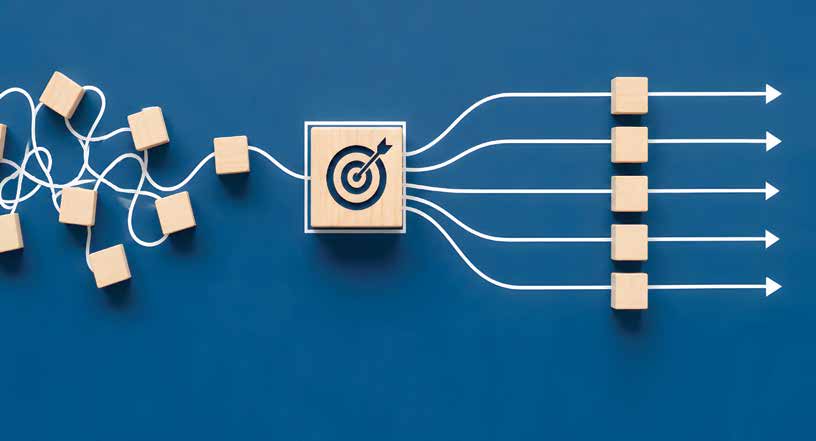
Many businesses grow organically, adding roles and responsibilities as new people join the team. Over time, this approach can create confusion about who owns critical parts of the business, leading to inefficiencies, frustration, and missed opportunities for growth.
What is organizational structure and design?
It is the process of stepping back to determine what roles are necessary to successfully support your organization’s needs today and in the future. It is asking the question, “if I didn’t have any people on my team, how would I ideally structure these roles to maximize results?”
Why does organizational structure and design help your business?
Organizations that lack organizational design often hear these frustrations from the team:
• “I don’t know what success looks like in this role.”
• “I’m missing information I need to do my work effectively.”
• “My decisions keep getting second guessed.”
• “I feel micro-managed.”
• “We keep tripping over each other and don’t know who’s responsible for this work.”
• “Somebody dropped the ball, but we don’t know who.”
These feelings can lead to higher turnover, inefficient operations, and challenges recruiting talent. Why?
Higher turnover – When roles are unclear, people start to become frustrated with the process, but also it begins to break trust across the team. We start to question whether the issue is the process or the people we are working with each day. When team members don’t trust one another, they are more likely to leave for other opportunities. Lack of role clarity leaves employees feeling unsupported and uncertain about expectations. Over time, this frustration can lead to burnout, disengagement, and ultimately turnover.

Inefficient operations – Lack of strong organizational structure can create a variety of inefficiencies depending on the team. Here are a few of the most common challenges:
• Team members hesitate to make decisions because they assume they do not have the authority.
• Individuals on the team duplicate efforts on processes.
• Information doesn’t get communicated to the appropriate individuals.
• Tasks get dropped despite the team’s best efforts.
Strong organizational structures provide team members with clarity on four key questions:
• Who does the work?
• Who makes final decisions?
• Who needs to be consulted along the way?
• Who needs to be informed of the progress or outcomes?
Challenges in recruiting – When organizational structures are unclear, companies often create “unicorn” positions – roles that combine responsibilities requiring multiple skill sets. These positions can be difficult to fill because few candidates possess all of the desired qualifications. As a result, positions remain open longer or organizations hire individuals who struggle to succeed in the role.
HOW CAN I IMPROVE THE ORGANIZATIONAL STRUCTURE?
Focus on the roles, not the names. Great teams are comprised of individuals who are willing to pitch in and do what it takes to achieve the goal. This can be our biggest asset as a team, but when we let this approach go on too long, it creates challenges in the organizational structure. We end up with unclear roles or responsibilities that get assigned based solely on the strengths of the current team. In order to create the ideal organizational structure, we need to lead with these questions:
- What is the work that needs to be done?
- If you could organize the work in the most logical way, what would it look like?
- If budget were not a constraint, how would you design this role?
- If I was building the structure today without any team members, what would be ideal?
Start from the top of the organization. All too often, organizations try to redesign a single role versus taking a holistic approach. In reality, what work you want the CEO or owner to focus on subsequently will change what roles you need within the rest of the organization. Based on this, you have to start at the top and work your way down to ensure you align the work in the most effective way.
Leverage great HR tools to support the team. It’s not enough for the leader to understand the organizational structure; every member of the team needs this level of clarity. Ask yourself, can my entire team draw the organizational structure and explain the “swim lanes” to a new hire accurately?
The best way to ensure you have this level of role clarity includes leveraging three important HR tools:
• Job descriptions
• R.A.C.I. charts (Responsible, Accountable, Consulted, Informed)
• Organizational charts
Where Do You Go from Here? Organizational structure is not just an HR exercise, it is a business strategy. Unfortunately, often we live with organizational structures that happen by accident. Instead, this strategy requires leaders to evaluate roles intentionally, clarify responsibilities, and align the structure with future business goals. The investment pays dividends through improved communication, stronger accountability, and better business results.
Katie Magoon is the founder of People Solutions Center, which provides human resources consulting services. She can be reached at 314.302.5969 or hr@peoplesolutionscenter.com.
